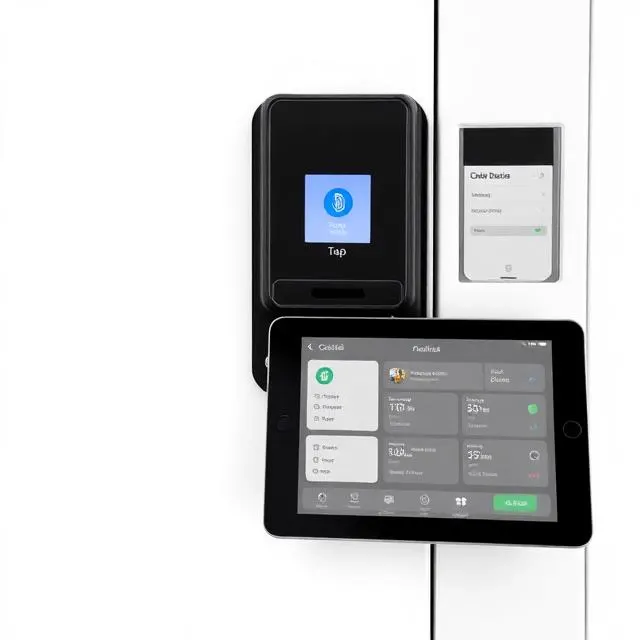
vending machine card reader Australia
The real cost of cash is your time, not your coins
Ask any operator who has run a cash route what their actual hourly rate is once cash handling is counted, and the number is confronting. Cash does not just sit in the machine waiting for you. It has to be collected on a specific schedule whether or not the site needs stock. It has to be transported. It has to be counted, reconciled against the machine's meter reading, bagged, and taken to a bank branch — and bank branches are closing, which means driving further, queueing longer and paying for parking you would not otherwise pay for.
Then there is the physical reality. A month of coin from a busy combination machine is genuinely heavy. Operators carry bags of coins from a staff room, across a car park, into a vehicle, out again at a bank. It is a back injury waiting to happen and it is completely unnecessary work in 2026.
Add up a modest route of eight machines. If cash handling costs two hours per machine per month across collection, counting, reconciliation and banking, that is sixteen hours — two full working days every month spent moving coins around. Value your time at even a conservative rate and cash is costing you more than the merchant fees on a cashless reader ever will. That is before you count coin jams, note reader faults, miscounts and the reconciliation arguments that follow.
- Collection trips driven by cash, not by stock
- Counting, bagging and reconciling every cycle
- Bank branch closures and parking costs
- Physical load and injury risk
Cash is a security problem you do not have to own
Cash makes you a target, and the vending industry knows it. Machines known to hold cash attract break-ins, and the damage bill from a forced door, a bent frame and a destroyed coin mech is routinely several times the cash that was taken. Sites that suffer repeat vandalism often ask for the machine to be removed entirely, so you lose the location as well as the hardware.
The risk follows you personally too. An operator carrying visible bags of coin on a predictable schedule, at predictable times, along a predictable route is exposed in a way most people would never accept in another industry. It is not a hypothetical — operators have been robbed doing exactly this.
A cashless machine removes the incentive. There is nothing inside worth forcing a door for. Money moves from the customer's card to the payment platform to your bank account without ever existing as a physical object in your possession. That is not a convenience improvement, it is a genuine safety improvement, and it is the single strongest argument for going fully cashless on new placements.
How the readers work: MDB, pre-authorisation and settlement
Every modern vending machine speaks MDB — Multi-Drop Bus — the standard serial protocol connecting the machine controller to its payment peripherals. A card reader is wired into that same harness and identified by the machine as a cashless device, which is why confirming a used machine has an MDB-capable board matters so much before you buy it.
The transaction sequence is fast and precise. The customer taps a card, phone or watch on the NFC pad. The reader contacts the payment platform over its mobile data connection and pre-authorises up to a ceiling amount. The machine sees available credit and releases the selection. The machine reports the exact vend price back down the MDB line, and the reader finalises the transaction at that value only — so a $3.20 drink captures $3.20, not the pre-auth ceiling.
That record then carries a complete data payload: machine identifier, selection, product, price, and an exact date and time stamp, tied to a tokenised reference for the card used. The provider settles the funds to your nominated account on their cycle, typically daily or weekly, with a statement you can reconcile against the machine's own DEX sales data.
Practically, installation is a plug-in job on a modern machine — mount the reader on the fascia, run the harness, configure the machine's cashless setting, test a live transaction. On older equipment you may need an MDB interface or a controller update, which is worth quoting before you commit to retrofitting a fleet of older units.
- MDB harness — same loom as the coin mech
- Pre-authorise, vend, capture exact price
- Mobile data SIM per reader
- Daily or weekly settlement to your account
Nayax, Circumtec, Vendcell and Cantaloupe
Nayax is the most visible name in Australian vending cashless. Its readers are widely deployed, the management platform is mature, and the ecosystem covers payments, telemetry, remote price changes, promotions and consumer loyalty in one place. For an operator planning to grow past a handful of machines, the depth of the platform and the availability of technicians who already know the hardware are strong arguments.
Cantaloupe comes from a route-management heritage rather than a payments-first heritage, and it shows in the back office. Warehouse and pre-kitting tools, driver routing, planogram optimisation and detailed reconciliation reporting are its strengths, which makes it attractive once your route is big enough that logistics — not payments — is the bottleneck.
Circumtec has a long-standing presence with Australian operators and is frequently chosen for competitive plan pricing and responsive local support. For small and mid-size routes where the deciding factor is monthly cost per reader and whether someone answers the phone, it is a serious contender.
Vendcell is similarly established in the Australian market and popular with operators who want straightforward cashless acceptance plus core telemetry without paying for enterprise features they will not use.
Compare on total cost at your actual volume, not headline rates. Model the hardware price, the monthly SIM and platform fee, the percentage and fixed component of the transaction fee, settlement frequency, contract length and exit terms. A reader with a lower monthly fee and a higher percentage fee can be cheaper on a quiet site and more expensive on a busy one — run both scenarios against a realistic 200 to 800 transactions per machine per month.
- Nayax — widest deployment, deepest platform
- Cantaloupe — route and back-office strength
- Circumtec — competitive plans, local support
- Vendcell — straightforward cashless plus telemetry
Telemetry: the data that changes how you run the route
The payment function pays for the reader. The telemetry function is what actually changes your business. Once every machine reports in real time, you stop driving to sites on a calendar and start driving to sites on demand. Fuel, hours and wear drop immediately, and the sites that genuinely need attention get it sooner.
Stock-out visibility is the biggest single revenue recovery. A sold-out selection earns nothing and quietly trains staff at that site to stop looking at the machine. With live sales data you know which coil emptied on Tuesday and can carry the right stock on Thursday rather than discovering it a fortnight later.
Planogram intelligence follows. The platform will show you, per site, which lines sell and which lines sit. Blue-collar warehouse sites and white-collar corporate sites want measurably different products, and the data lets you tune each site instead of running one generic planogram across the whole route.
Fault and temperature alerts protect both revenue and reputation. A refrigeration deck drifting out of range is an alert on your phone rather than a complaint from the site manager and a bin full of spoiled stock. On food and chilled product, that temperature log is also a food-safety record.
Finally, the timestamped transaction record has an evidentiary value that operators rarely appreciate until they need it. If a person claims they became unwell from a product allegedly bought from your machine, telemetry can establish whether a transaction occurred at that machine at that time, exactly which selection was dispensed and at what price, tied to a tokenised card reference. Combined with your stock and temperature records, that is precisely the evidence your insurer wants when defending a product liability claim.
Questions operators ask
- How does a vending machine card reader actually work?
- The reader plugs into the machine's MDB harness — the same loom the coin mech and note reader use — and presents itself to the machine as a payment device. When a customer taps, the reader pre-authorises an amount, tells the machine credit is available, the machine vends the selection and reports the exact price back, and the reader captures only that amount. The transaction is sent over a mobile data SIM to the provider's platform and settled into your bank account, usually daily or weekly.
- Which card reader is best for Australian vending machines?
- Nayax is the most widely deployed in Australia with a mature telemetry and management platform. Cantaloupe is strong on route management and back-office reporting, particularly for larger fleets. Circumtec and Vendcell are well established with Australian operators and often more competitive for small routes on plan cost and local support. The correct choice usually comes down to fee structure at your transaction volume, and how good the local support is when a reader drops offline.
- Does going cashless increase vending sales?
- Consistently, yes. Australian operators typically report 15 to 30 percent revenue uplift after fitting readers, for two reasons: nobody carries coins anymore, so cash-only machines simply lose those sales, and average transaction value rises because a tap of $4.50 does not feel like counting out $4.50 in silver.
- What does telemetry give me beyond taking payments?
- Every sale is timestamped with the selection, the price, the machine and the card token. That gives you remote stock levels so you only drive to sites that need filling, fault and temperature alerts, planogram data showing which selections earn and which are dead, and an evidentiary record — date, time, product, price, card token — that becomes extremely important if anyone ever alleges they were harmed by a product from your machine.
Related searches
vending machine card reader australianayax australia vendingcantaloupe card reader vendingcrimtec vending paymentvendcell card readercashless vending machine paymentvending telemetry australiatap and go vending machine